Otto Laske Interdevelopmental Institute (IDM)
Creating Collaborative Intelligence
IDM – An Institute Supporting the Art and Science of Transforming Organizational Cultures
In today's tumultuous global environment, organizations and institutions face many critical challenges.Two of them stand out:
- Strengthening innovation
- Supporting self-organizing teams that strive to handle real-world complexity integrally and holistically

A celebration of '20 Years of IDM'
Celebration of Otto Laske's work, December 21, 2023
Our value proposition in addressing these issues is based on validated developmental research outcomes accrued since 1975. The focus of the research is better to understand individuals' and teams' emotional and cognitive journey into, and even beyond, self-authoring.
Our value proposition derives from the insight that at any point of their development, adults need scaffolding and receptive listening to buried voices in themselves. The research referred to, most of it done at the Harvard Kohlberg School, paved the way to CDF, the Constructive Developmental Framework (Laske 1999-2000), a set of novel assessment, dialog, and listening tools for spurring innovation. Organizational innovation, for us, amounts to freeing work from the shackles of hierarchical as well as neo-tayloristic, sprint-like constraints that distort and hold up individuals' own developmental agenda while they get "the job done faster" only in an illusory fashion.
We excel in what we do in, and by, turning our own experience with clients right back to them through dialog, engaging them in understanding what was just said. In this way, we work "in the moment", promote self-awareness and create open dialog systems. We view this way of consulting and diagnosis as a path leading to 'deliberately developmental organizations' in which the from-the-outside-in path is held in equilibrium with the inside-out one, both by individuals and in teams. In this way, we promote self-organization and put small and large teams on a path toward collaborative intelligence.
We are known for encouraging our clients to bring to life in themselves forms of meta-thinking. These forms shed light on the structural limits of their logical thinking. On this level of "reasoning" rather than mere "thinking", we provide, and expertly model, evidence that "one can view this situation quite differently and more integrally", whether it be a business model canvas or a team's performance involving its construction.
Our key resources for revolutionizing the engagement with others and their unique world derive from DTF (Dialectical Thought Form Framework), CDF's cognitive core set of tools. By exercising and teaching them expertly, we help clients move everyday discourse — and thus also business-as-usual — from logic-analytical and systems thinking to what we call transformational thinking. Such thinking does not stop at dealing with mere "change", but continues through to understanding transformation in the real world (of which change is but a symptom).
Transformational thinking naturally engenders emotional openness and the acknowledgement of others as peer knowledge holders, erecting a bulwark against defensiveness.
All CDF tools function on the meta-level of co-reflection with others. On that level, every object is only a pointer to incomplete thinking, not the "thing-in-itself" that thinking aims for. As a result, the structure of individuals' reasoning in real time becomes the prime target of attention.
Laske's Constructive Developmental Framework (CDF) is our principal methodology. The tools it provides us with emerged from listening to clients in semi-structured interviews (Kegan 1982; Basseches 1984), and are thus dialogical by nature. When dialogical — rather than monological — tools are used, they put to rest the illusion that language describes rather than creates the world. The frightful realization of this truth does not need to lead to loss of self-confidence, but once absorbed, opens up a large number of buried resources, including one's own voice.
As interviewing and listening experts, we are keenly aware of the limits of (mono-) logical thinking exercised in the effort to discover what is real. We provide a perspective of critical realism regarding the world, not only the world designed by people, but the much larger world outside of it in which human designs are embedded. In consequence thereof, our world is not only designed in a lean and agile, but also deep, way. It is closer to the real world than purely logical thinking can ever hope to come.
And therefore it also scales well.
All offerings of the Interdevelopmental Institute (IDM)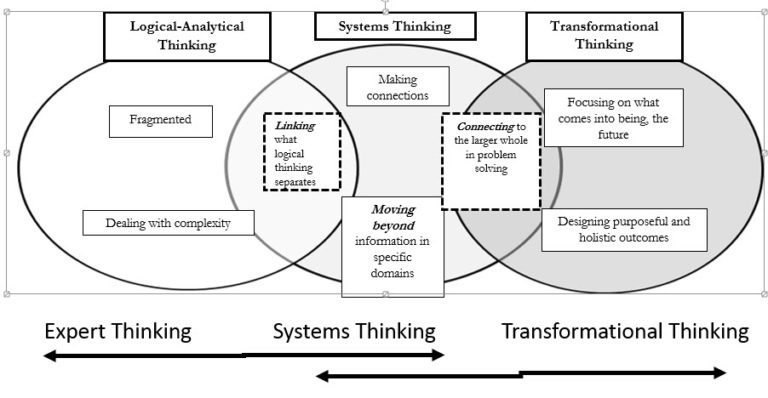
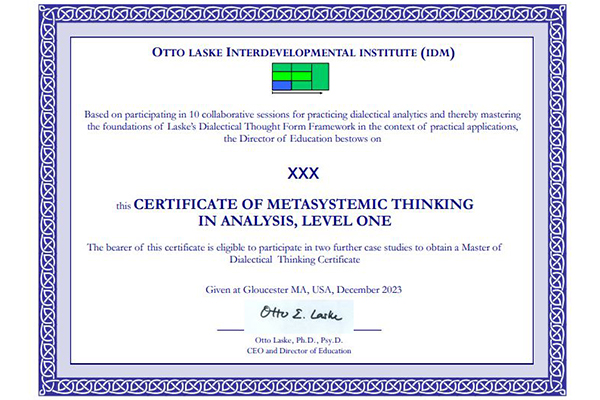
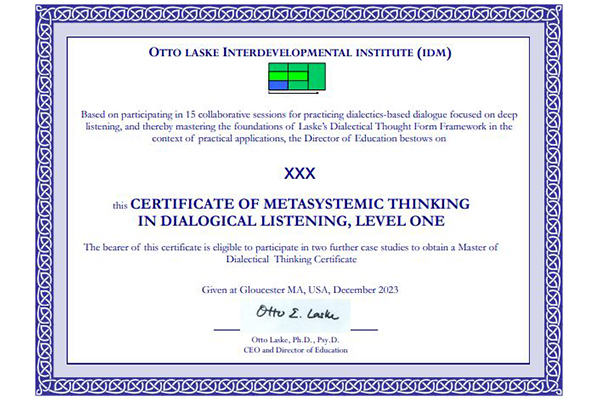
Interdevelopmental Institute Certificate
Complex Thinking for Integral Leaders
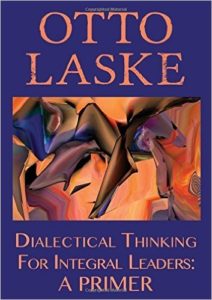
This first book on complexity thinking and dialog for integral leaders will come in handy at a time of great turmoil in the global economy, reflected in organizational attempts at agile thinking, lean start ups, and forestalling the risk of defeat by disruptive business models. The author critiques the sole reliance on formal logical thinking, showing how via systems thinking a path can be cleared to what he calls transformational thinking, based on Roy Bhaskar's Dialectical Critical Realism.
In particular, the book focuses on teams and pods, pointing to both the risks and opportunities of flexible managerial hierarchies and distributed leadership. It not only teaches the rudiments of transformational thinking but also gives many examples of how to boost complex dialog — connected to the real world — in teams.
By introducing the four moments of dialectic and their associated thought forms, the book suggests avenues toward transforming organizational and institutional cultures through dialog, opening up new agile action logics beyond purely logical thinking.